
The December Timeline: What OpenAI's Admission Means for Enterprise AI
3 days. 3 blog posts. 1 unavoidable truth about AI security that every executive needs to understand.
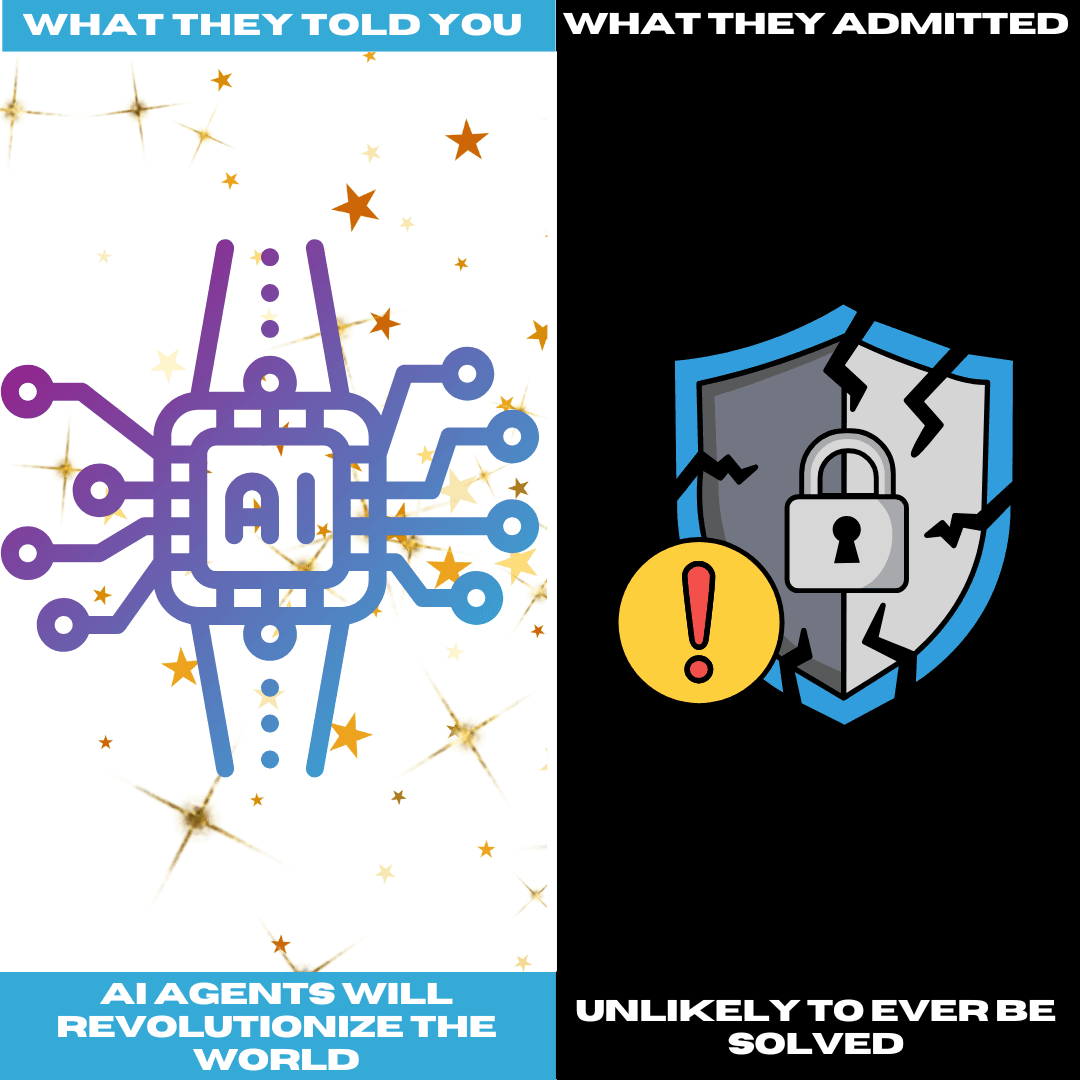
Three days in December that changed the conversation about AI security in ways most enterprises haven’t processed yet.
December 10, 2025: OpenAI publishes a blog celebrating their cybersecurity capability increase. Their AI’s performance on capture-the-flag challenges jumped 185% in three months, from 27% to 76%. The message: look how good we’re getting at security.
December 22, 2025: Same company, different message. OpenAI publishes another blog post admitting that prompt injection attacks are “unlikely to ever be fully solved.” Not “we’re working on it.” Not “we have a roadmap.” Unlikely to ever be fully solved.
December 23, 2025: 24 hours after that admission, OpenAI’s CISO Dane Stuckey posts on X: “As we plan next year’s ChatGPT security roadmap, what security, privacy, or data control features would mean the most to you?”
They’re asking for security feature suggestions the day after admitting the core security problem can’t be fixed.
That tells you everything you need to know about priorities in the race to deploy AI agents. If you’re a CISO, CTO, or executive responsible for AI deployment decisions, this timeline should fundamentally change how you evaluate vendor claims, assess risk, and build governance frameworks.
Here’s why.
The Structural Problem OpenAI Can’t Fix
The admission on December 22, 2025, wasn’t about a software bug. It was about fundamental architecture.
Humans see pixels. AI agents read code.
When you navigate a website, your brain processes visual hierarchy.
- You see headlines in large fonts.
- You scroll past ads.
- You spot suspicious links based on context and experience.
You have decades of pattern recognition telling you what to trust and what to ignore.
But when an AI agent encounters that same webpage, it processes HTML structure. Every element carries equal authority. Every piece of code is potential instruction.
- That hidden HTML comment developers use for notes? Your AI agent reads it as authoritative input.
- That base64-encoded string in a tag attribute? Decoded and processed as a command.
- That div with display:none containing text you never see? Your agent interprets it and acts on it.
Every webpage becomes an attack vector because AI agents cannot distinguish between content designed for human visual perception and malicious instructions embedded in code structure.
This isn’t theoretical.
Security researchers demonstrated this on October 21, 2025 (the day ChatGPT Atlas launched). They showed that a few words in a Google Docs comment could change the browser’s behavior. Brave published research the same day calling prompt injection “a systematic challenge for AI-powered browsers.”
Two months later, OpenAI admitted what researchers already knew: the vulnerability is structural, not patchable.
The UK Government Confirms What Vendors Won’t Say
Before you think this is one vendor’s problem, consider who else is saying the same thing.
The UK’s National Cyber Security Centre (the government body responsible for protecting critical national infrastructure) published a blog post in December 2025 titled “Prompt injection is not SQL injection (it may be worse).”
Their conclusion: prompt injection attacks “may never be totally mitigated.”
When the UK government’s official cybersecurity authority and the world’s leading AI company independently arrive at the same conclusion, executives need to pay attention. The recommendation from the UK NCSC? Organizations should focus on limiting damage, not preventing attacks.
Read that again.
The official position is that prevention may be impossible.
Your security strategy must assume breach.
The Breach Statistics You Need to Know
While OpenAI celebrated capability improvements and asked for feature suggestions, reality was already providing answers. Bitdefender research found that 63% of IT professionals reported their organizations experienced AI-enabled cyberattacks within the last twelve months.
Not “might experience in the future.” Already experienced.
This isn’t a hypothetical risk you’re evaluating for potential deployment; this is active exploitation happening at nearly two-thirds of organizations right now.
Think about what that means for your risk calcs:
- If you deploy AI agents, you have a 63% probability of breach within 12 months
- Your incident response plan needs to account for certainty, not possibility
- Your ROI calculations need to include breach costs: forensics, notification, regulatory penalties, litigation, reputation damage
- Your cyber insurance premiums will reflect this risk (if coverage is even available)
OpenAI’s Atlas launched in October 2025. The 63% breach rate existed before Atlas shipped. This isn’t a problem vendors are racing to solve; this is a problem vendors are accelerating by deploying increasingly capable agents into an environment where the majority of organizations already get hit.
What Independent Research Revealed
An academic study published in December 2025 on arXiv provided the most comprehensive security assessment of AI browser agents to date.
The researchers tested eight major products:
- ChatGPT Atlas (OpenAI)
- Google Project Mariner
- Amazon Nova Act
- Perplexity Comet
- Browserbase Director
- Browser Use
- Claude Computer Use (Anthropic)
- Claude for Chrome (Anthropic)
The findings: 30 vulnerabilities across all products tested.
The critical detail: Every single product had at least one critical security issue.
The researchers followed responsible disclosure practices, notifying all vendors at least 90 days before publication. Several vendors marked the vulnerabilities as second-highest priority level.
Yet every product shipped anyway.
This isn’t one company’s problem. This is a category-wide security failure where market pressure to ship is overriding security fundamentals.
What Gartner Recommends (And Why It Matters)
Gartner (considered the most influential technology advisory firm in enterprise IT) doesn’t issue blanket “block this technology” recommendations lightly. But in December 2025, they did exactly that. The advisory, titled “Cybersecurity Must Block AI Browsers for Now,” came from analysts Dennis Xu, Evgeny Mirolyubov, and John Watts. The recommendation was unambiguous:
“CISOs must block all AI browsers in the foreseeable future to minimize risk exposure.”
Not “proceed with caution.”
Not “implement additional controls.”
Not “evaluate your specific risk tolerance.”
Block entirely.
Their reasoning focused on three core risks:
- Indirect prompt-injection-induced rogue agent actions
- Inaccurate reasoning-driven erroneous agent actions
- Credential loss if AI browsers are deceived into autonomously navigating to phishing websites
The fundamental issue: default AI browser settings prioritize user experience over security. And the architectural gap between human visual perception and AI code processing creates vulnerabilities that additional controls cannot fully mitigate.
When the firm that shapes enterprise technology strategy tells you to block an entire product category, that’s not caution. That’s a clear signal about unmanageable risk.
The Infrastructure Reality Nobody’s Discussing
Here’s what making AI agents structurally secure would actually require:
- New protocols that distinguish between content intended for humans and commands intended for AI agents at the foundational level of how information is transmitted online.
- Universal markup standards that explicitly separate data from instructions across every platform, website, and document format on the internet.
- Authenticated content sources where AI agents can cryptographically verify the origin and integrity of every piece of input they process.
- Standardized security layers implemented across billions of websites, not as optional add-ons but as mandatory infrastructure.
- Complete redesign of how information is structured, stored, and transmitted across the entire internet.
The cost to build this infrastructure: trillions of dollars.
The timeline to deploy it: decades.
The coordination required: every website, every platform, every content management system, every document format, every API rebuilt from the ground up with AI agents in mind.
OpenAI knows this infrastructure doesn’t exist. They know it won’t exist in time. They know the internet was optimized for human visual perception and changing that fundamental architecture requires restructuring the digital world.
They’re shipping AI agents anyway.
Because waiting for infrastructure means losing market share to competitors willing to deploy vulnerable products today.
The $830 Billion Question
OpenAI is raising up to $100 billion at an $830 billion valuation, according to Wall Street Journal reporting from December 19, 2025.
Think about what they’re asking sovereign wealth funds and institutional investors to bet on:
- A company that admits its core security vulnerability is “unlikely to ever be fully solved”
- Products operating in environments where 63% of organizations already experience AI-enabled attacks
- Technology that independent researchers found has critical security issues across every major implementation
- Infrastructure that would require trillions in investment and decades to secure, with no commitment from any party to build it
- A CISO asking users for security feature suggestions 24 hours after the company admitted the fundamental problem can’t be fixed
That’s not a growth story based on solving hard problems. That’s a bet that the market will accept permanent, unfixable vulnerabilities as “the price of doing business with AI” because the pressure to deploy is stronger than the risk of breach.
It’s liability arbitrage at unprecedented scale.
What Every Executive Must Do Now
If you’re deploying AI agents (or evaluating whether to deploy them), here’s what the December 2025 timeline demands:
Immediate Technical Actions
- Audit AI agent permissions immediately
What can your AI agents access? What code can they interpret as commands? What systems can they modify? What data can they exfiltrate?
If you don’t have precise answers, assume compromise is possible and work backward from there.
- Implement human verification for high-risk actions
Every AI-initiated action involving financial transactions, data modification, or external communications needs human approval before execution.
Yes, this defeats the efficiency promise. No, you don’t have a choice if you want to manage liability.
- Segment AI access with structural boundaries
Research agents should be isolated from operational agents. Different privilege levels. Different data access. Different code interpretation permissions. Different blast radius.
When breach happens (and with 63% statistics, it will), you need containment.
- Deploy input sanitization for AI interpretation
Traditional input validation protects against SQL injection and XSS. You need new controls that prevent prompt injection in every text field, every comment section, every data input point your agent can access.
- Monitor for structural anomalies
Traditional security tools flag suspicious-looking links that humans might click. You need systems that detect when agents process hidden code, nested instructions, or unusual HTML structures invisible to human users.
- Document everything
When the breach happens and the lawsuit starts, you need evidence that you implemented reasonable safeguards against a known, vendor-admitted, unfixable risk.
“We trusted the vendor” will not protect you when plaintiff’s attorneys have OpenAI’s December 22nd blog post admitting the problem is “unlikely to ever be fully solved.”
Strategic Governance Changes
Reassess AI ROI with breach probability factored in
If 63% of organizations experience breaches within 12 months, your cost model must include:
- Incident response and forensics: $500K to $2M
- Regulatory penalties (varies by jurisdiction and data type): $100K to $10M+
- Litigation and settlements: $1M to $50M+
- Reputation damage and customer loss: Incalculable but real
Now, what’s the ROI of your AI deployment when you add $2M to $10M in probable breach costs?
Build governance that assumes breach, not hopes to prevent it
Your AI governance framework needs:
- Incident response plans specific to AI agent compromise
- Notification procedures for when agents execute malicious instructions
- Legal review of liability when agents can’t distinguish legitimate from malicious commands
- Board-level risk acceptance of deploying systems with vendor-admitted unfixable vulnerabilities
Question vendor promises with forensic precision
The December timeline gives you a template for vendor evaluation. When AI companies celebrate capability improvements while admitting core vulnerabilities are unfixable, then ask for feature suggestions, that reveals priorities.
Five Questions to Ask Every Vendor BEFORE your next AI deployment decision:
1. “Show me independent security audits of your prompt injection defenses.”
Not internal testing. Not partner testimonials. Independent verification from recognized security firms with public reports you can review.
If they don’t have them, well, that’s your answer.
2. “How do you solve the structural navigation vulnerability where AI reads code instead of pixels?”
The only acceptable answer is: “We can’t fully solve it. Here’s our mitigation strategy, here’s the residual risk, here’s what we’re doing to minimize exposure.”
If they claim to have solved it, they’re either lying or don’t understand their own product. Either way, it’s disqualifying.
3. “What percentage of your customers have experienced AI-enabled security incidents?”
If they won’t share numbers while 63% of organizations are breached industry-wide, assume their numbers are worse.
4. “What’s our liability when your AI agent executes malicious code it structurally cannot distinguish from legitimate content?”
If they can’t provide a clear legal answer with indemnification terms, you’re signing a blank check your insurance won’t cover.
5. “How do we prove we implemented reasonable safeguards against an admitted unfixable vulnerability?”
This is the question that matters when you’re in litigation. The plaintiff will have OpenAI’s admission. The regulator will have the UK NCSC’s confirmation. You need documentation that you took reasonable steps knowing the risk was permanent.
Your Strategic Options
The December timeline clarifies your choices:
Option 1: Deploy Now with Eyes Open
Accept the risk. Implement every safeguard possible. Document everything. Build incident response assuming breach certainty rather than breach possibility.
This is viable if:
- The business value clearly exceeds breach costs in your specific use case
- You have board-level risk acceptance in writing
- You have dedicated resources for monitoring, containment, and response
- You have legal review of liability implications
- You can afford the probable breach without existential risk to the business
Option 2: Strategic Delay
Wait. Watch competitors’ failures. Deploy in low-risk scenarios while technology matures and infrastructure potentially catches up.
This is viable if:
- You can explain to your board why competitive pressure doesn’t justify unmanageable risk
- You have alternative approaches to achieve similar business outcomes
- You can absorb short-term competitive disadvantage for long-term risk management
- You have the organizational patience to let others be the cautionary tales
The unaffordable option: Pretending the risk doesn’t exist because competitors are deploying. When 63% of organizations experience breaches, the vendor admits the vulnerability is unfixable, the UK government confirms it may never be mitigated, independent research finds critical issues in every product, and Gartner recommends blocking the entire category, ignorance of risk is not a defense.
It’s negligence with a paper trail.
What This Means for the Industry
The December 2025 timeline represents a watershed moment in enterprise AI deployment.
We now have:
- Vendor admission that core vulnerabilities are unfixable
- Government confirmation that attacks may never be mitigated
- Independent research showing universal critical security issues
- Expert recommendation to block the technology entirely
- Majority-of-market breach statistics in active operation
- A CISO asking for feature suggestions while admitting the problem can’t be solved
This is the moment where move fast and break things collides with break things and face unlimited liability.
The companies that recognize this inflection point and adjust their deployment strategies accordingly will have competitive advantage when the inevitable high-profile breaches occur.
The companies that ignore it because everyone else is deploying will become the case studies that prove the warnings were correct.
The Bottom Line for Enterprise AI
December 10th: OpenAI celebrates 185% cybersecurity capability increase.
December 22nd: OpenAI admits the core vulnerability cannot be fixed.
December 23rd: OpenAI asks what security features you want.
The infrastructure isn’t ready.
The security isn’t possible.
The attacks are already happening at 63% of organizations.
You read pixels. AI reads code. That gap is architectural, not patchable.
The question facing every enterprise executive is whether to deploy systems with permanent vulnerabilities into environments structurally incompatible with safe operation. Based on OpenAI’s own admission from December 22nd, that answer should inform every deployment decision you make. This isn’t about being anti-AI or being a doomer. This is about being pro-reality.
AI agents are powerful tools with transformative potential. They’re also systems operating in environments they can’t safely navigate because of fundamental architectural mismatches that vendors admit they can’t fix.
Your job as an enterprise leader isn’t to deploy AI because it’s innovative. Your job is to deploy technology that creates value while managing risk at acceptable levels.
When the vendor admits the risk is permanent, the government says it may never be mitigated, independent research finds universal critical issues, and the majority of organizations are already breached, “acceptable levels” needs rigorous definition.
OpenAI’s December timeline gave you the information you need to make informed decisions.
What you do with that information will determine whether you’re ahead of the curve or part of the cautionary tale.